
Photon-counting CT (PCCT) Scans Sydney
Computed Tomography (CT) is an imaging test that uses X-rays and computer processing to create detailed cross-sectional pictures of the body. It helps doctors see internal organs, blood vessels, bones and soft tissues in far more detail than a standard X-ray.
With photon-counting CT, we use the latest generation of CT technology. Instead of simply measuring the total X-ray signal like a conventional scanner, photon-counting CT can detect and count individual X-ray photons and measure their energy. In practical terms, this means:
- Sharper images, especially of small or fine structures
- Less image noise and blur, so details are easier to see
- More information from every scan, without needing extra radiation
Photon-counting CT allows us to produce high-quality images at a lower radiation dose, supporting accurate diagnosis while keeping your safety and comfort at the centre of care.
Bulk billing: Photon-counting CT scans at Harbour Radiology are bulk billed for all patients with a valid referral and a Medicare card.
Photon-counting CT services
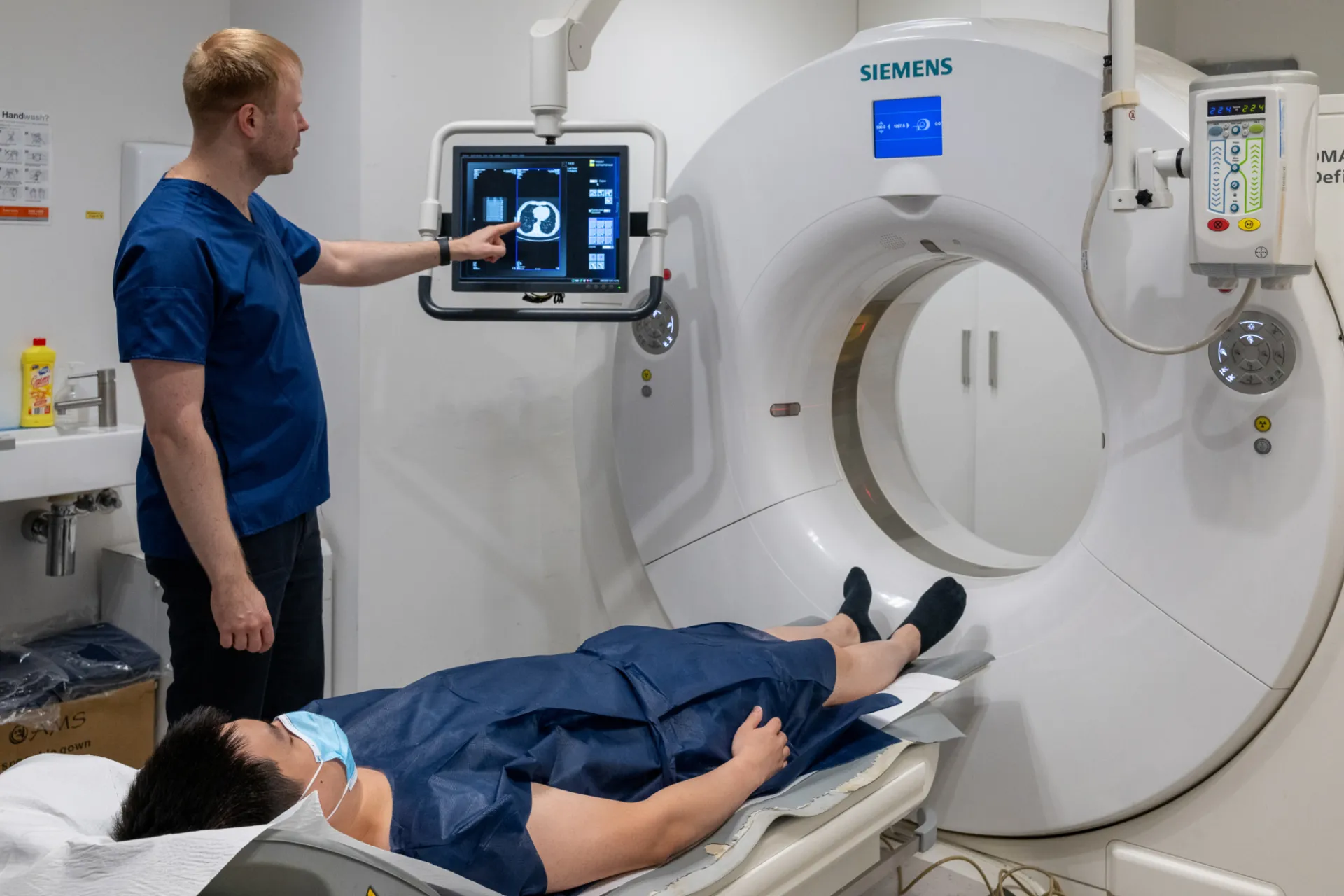
Harbour Radiology has invested in the state-of-the-art Siemens NAEOTOM Alpha.Prime photon-counting CT scanner at our North Sydney and Hoxton Park practices, to reduce radiation exposure wherever possible without compromising on diagnostic quality. Because the detector is more efficient and can “sort” photons by their energy, we can often:
High resolution, low dose
- Use thinner image slices for very fine detail
- Improve soft-tissue contrast, helping to distinguish between different organs and tissues
- Maintain or reduce dose compared to standard CT, while still seeing more
According to Siemens Healthineers, photon-counting CT can produce image slices as thin as 0.2 mm, and can reduce radiation dose by up to 45% for ultra-high-resolution scans compared with conventional CT detectors. The dose for your scan depends on the type of examination and is always kept as low as reasonably achievable.
Photon-counting CT is particularly useful for:
- Cardiac CT (coronary CT)
- Paediatric imaging, where a lower radiation dose matters most
- Oncology imaging
- High-resolution CT (HRCT) of the chest
- Vascular imaging
- ENT and orthopaedic imaging
We perform photon-counting CT for a wide range of diagnostic questions. Depending on your referral, we may scan a specific region or multiple areas.
Common photon-counting CT scans include:
- Head & brain
- Neck
- Chest and lung
- Abdomen & pelvis
- Cardiac and coronary
- Spine CT (cervical, thoracic, lumbar)
- Musculoskeletal(e.g. shoulder, knee, hand, foot)
- CT angiography (blood vessels)
If the scan you need is not listed here, please contact our team – we will be happy to advise.

Photon-counting CT: what to expect
Photon-counting CT uses X-rays to create very thin “slices” through the body, which are then reconstructed into 2D and 3D images. Because the scanner can analyse each photon separately, it provides:
- Crisp detail for small structures and fine anatomy
- Improved soft-tissue contrast, helping to highlight subtle changes
- Dose-efficient imaging, so we can keep radiation as low as reasonably achievable
During your scan
- You will be asked to lie on a padded table that moves slowly through the CT scanner.
- The scanner is open at both ends and does not fully enclose you.
- You will need to lie still, and you may be asked to hold your breath for a few seconds at a time.
- The radiographer will be in the next room, able to see and hear you at all times, and will give you instructions via intercom.
- The photon-counting CT scan itself is usually very quick – often only a few minutes of actual imaging time.
How to prepare for a Photon-counting CT scan
Our staff will confirm any specific preparation when you make your booking, as it depends on the type of scan.
General guidance may include:
Food and drink
For many scans, you can eat and drink normally.
Medications and health conditions
- Please tell us if you have kidney problems, diabetes, thyroid disease, asthma or any history of reaction.
- Bring a list of your current medications. Some diabetes medicines and other drugs may need to be managed around your appointment.
Clothing and jewellery
- Wear comfortable clothing without metal zips, buttons or underwire if possible.
- You may be asked to remove jewellery, watches or other metal objects in the area being scanned.
If you are pregnant or think you may be pregnant, please let our staff know when booking and again on arrival. We will discuss the safest imaging option for you.
After your scan
Most patients can return to normal activities straight after their photon-counting CT scan.
If you feel unwell after you leave the clinic or have any concerns, please contact us or seek medical advice.